Barbaric Spheres: April 2026
Oil in the Aries Age
Saturn, Neptune, and the End of the Petrodollar
Jon Kraft — April 3, 2026
Table of Contents
— The Argument —
- Thesis
- What This Document Is
— The Conflict —
3. The War and Its Nativity
4. The Structural Framework
5. The Prediction Calendar
6. Eclipse Analysis
7. The War Arc: Five Structural Phases
8. The April 19–20 Declaration Window
— The Markets —
9. The Price Picture
10. Scenario Analysis
11. The Long Arc: 2026–2039
— Method —
12. Methodology
13. Postscript
Appendix: Key Dates at a Glance
1. Thesis
The war that began on February 28, 2026 did not arrive without warning in the sky. The astrological conditions framing it have been developing for decades: a Saturn-Neptune conjunction at the World Point — the zodiac's cardinal ingress, associated in the mundane tradition with events of civilizational rather than merely national scale — coinciding with an armed closure of the Strait of Hormuz for the first time in the modern era. Six separate founding charts of petroleum-system institutions concentrate their planetary positions within a single degree of middle Aries, where Saturn will station retrograde in July 2026. A total lunar eclipse in March struck the natal and progressed Ascendant of the United States within minutes of arc. A Mercury-Mars-Saturn triple conjunction in April is tighter than any in the ninety-six-year record surveyed. The secondary progressions of the primary global crude oil pricing instrument are seeding a new thirty-year cycle on the summer solstice.
The argument of this document is that these configurations are not coincidental accumulation. They are the celestial conditions under which a civilization-scale transformation of the petroleum order becomes possible — and, the author argues, structurally inevitable. The war is not an interruption of normal conditions. It is the kinetic surface of a transformation already written in the cycles the oil system has followed since its founding.
The predictions in this document were formulated before the war began. Six foundational predictions have since confirmed. The April-through-August window now opening contains the document's primary structural claims. The author offers them as a matter of record, with explicit falsification criteria.
2. What This Document Is
The Oil Corpus is a research program in mundane astrology — the branch of the discipline concerned with the charts of nations, institutions, markets, and historical events. The corpus consists of approximately fifty-five natal charts for entities that collectively constitute the modern petroleum order: founding dates for major oil companies, international treaty bodies, commodity exchanges, producing nations, and the political agreements that have structured the global oil trade since the mid-nineteenth century.
From these charts the author derives a set of structural relationships and timing cycles. The primary cycle is Saturn-Neptune, which operates on a thirty-six-year periodicity and has coincided with each major disruption to the petroleum order since 1846. Secondary timing signals come from eclipse series, planetary station points, and the secondary progressions of key natal charts.
This is the third edition of a plain-language summary intended for readers without a background in astrology. Technical notation has been minimized; where astrological terms are unavoidable, they are defined in context. All specific planetary positions cited have been verified computationally using Swiss Ephemeris software. The main corpus (Oil Corpus — Iran War 2026, Parts I–X, approximately 2,500 lines) contains the full technical apparatus, prediction tracker, event log, and natal chart index from which this summary is derived.
— The Conflict —
3. The War and Its Nativity
February 28, 2026: The Opening
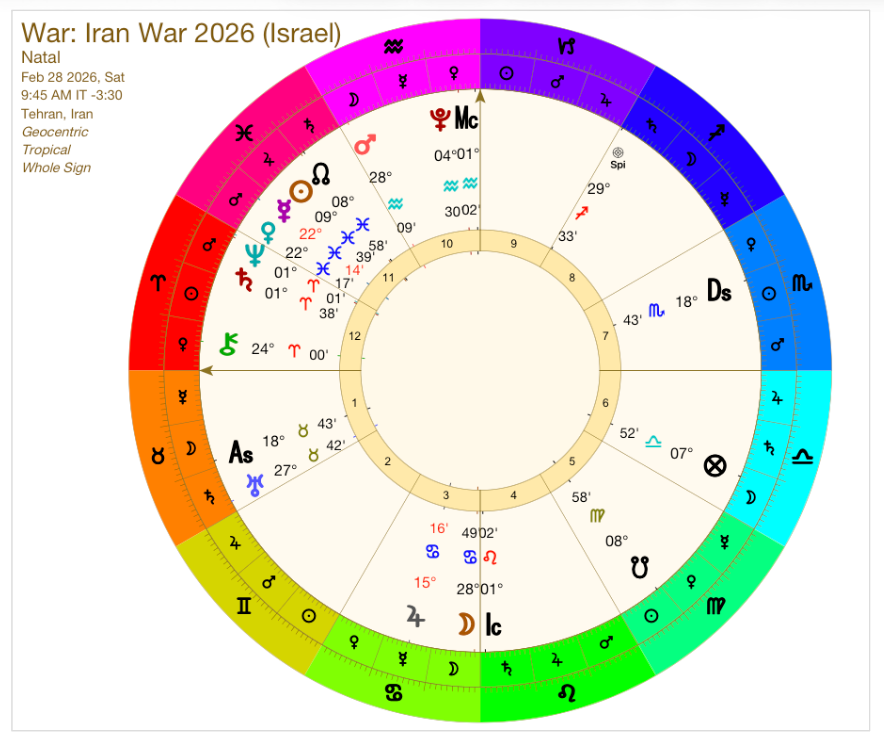
The war began at 09:45 Tehran time on February 28, 2026, when Israeli airstrikes struck a coordinated set of Iranian military and leadership targets. Supreme Leader Ali Khamenei was killed in this opening wave — the decapitation of the Iranian state as the war's first act — and his death was confirmed by the Iranian government on March 1. American Tomahawk cruise missile launches began twenty minutes after the first Israeli strikes, at 10:05 Tehran time. The war is a joint US-Israeli operation from its first hour.
The War Chart and the JCPOA Withdrawal
The Ascendant of the war's natal chart — the eastern horizon at Tehran at the moment of first strike — falls at Taurus 18°42'. The natal Sun of the JCPOA Withdrawal chart (May 8, 2018, when the United States formally exited the nuclear agreement) stands at Taurus 18°05'. These two positions are separated by less than one degree.
In mundane astrology, the Ascendant is the body of the event: the essential circumstances in which it is clothed, the form it takes as it rises into the world. This war rises from the zodiacal degree at which the last diplomatic framework against it was dissolved. The argument is not merely that the JCPOA's failure caused the war — that is a matter of political analysis. The argument is that the war's natal chart is constituted by the solar position of the agreement's death, to within a single degree. The two events are not merely historically related; they share a zodiacal identity.
Saturn-Neptune in the Twelfth House
The war nativity rises with Taurus on the Ascendant, placing Aries in the twelfth house. Saturn at Aries 01°37' and Neptune at Aries 01°00' — the conjunction that defines the structural character of the entire 2026 period — are both in H12 of the war chart. The twelfth house in mundane astrology governs hidden operations, covert action, secret enemies, and matters concealed from public view. The same degree is occupied by the Fordow nuclear enrichment facility's natal Uranus at Aries 01°01' — the underground facility woven into the war chart's hidden house at the founding degree.
The war rises, then, not with its structural purpose plainly declared, but with the dissolution of institutional form operating beneath the surface: in the covert intelligence layer, in underground facilities, in financial architectures not fully visible on the battlefield. Saturn-Neptune in H12 does not mean the war lacks structural consequence — the Saturn-Neptune conjunction is the most significant structural signal in the corpus. It means that consequence unfolds through concealment, through the covert and the underground, before it surfaces as declared political reality. The April 19 Declaration Window, discussed in Section 8, is precisely the moment at which what has been operating in the twelfth house begins to surface as formal articulation.
Algol and the Decapitation
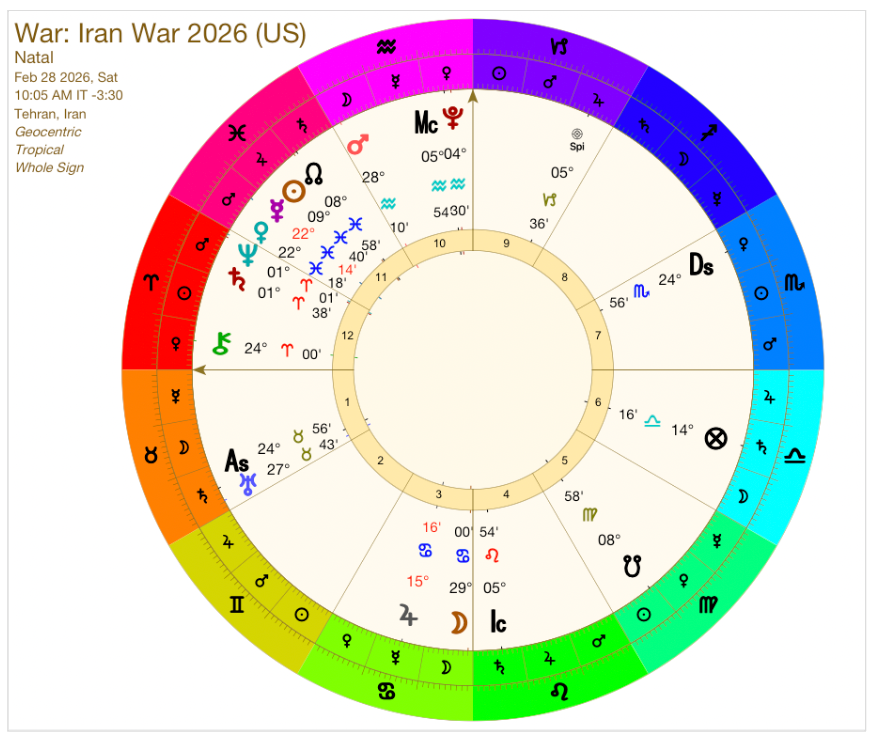
Twenty minutes after the first Israeli strikes, US Tomahawk missiles arrived over Tehran at 10:05 IRST on February 28. The Ascendant at that moment — the eastern horizon at Tehran — stood at Taurus 24°56'. The fixed star Algol, Beta Persei, occupied Taurus 26°22': 1°26' from the Ascendant, within the standard 1°30' threshold for effective angular fixed-star contact.
Algol carries one of the most precisely specified delineations in the traditional canon. Its Arabic name, ra's al-ghul — the demon's head — identifies it as the severed head of Medusa in the hand of Perseus, marking the eye or in some traditions the cut neck. In the medieval Arabic sources, in William Lilly, and in the systematic fixed-star literature through Reinhold Ebertin and Vivian Robson, Algol at an angular point in an event chart produces one consistent reading across centuries of commentary: the violent removal of leadership, beheading or its institutional equivalent, the sudden and catastrophic end of the governing principal. It is the most consistently malefic star in the Western tradition — not through accumulated lore but because its delineation has been tested against events and held.
Transit Uranus at 10:05 IRST stood at Taurus 27°42': 1°20' past Algol, 2°46' ahead of the Ascendant. All three — Ascendant at Taurus 24°56', Algol at Taurus 26°22', Uranus at Taurus 27°42' — rose simultaneously in a 2°46' arc. Uranus was conjunct Algol by 1°20', within standard orb for Uranus-fixed-star contacts. In the modern tradition, Uranus in proximity to Algol specifies the mode of the Algol event: not private violence or internal collapse, but sudden, organized, technologically delivered disruption of sovereign function. Algol without Uranus can mark illness, natural death, or internal usurpation. Uranus on Algol marks the precision strike — the externally executed, technologically mediated removal of the head of state as a deliberate act.
Three bodies in a rising arc of 2°46': ASC Taurus 24°56' · Algol Taurus 26°22' · Uranus Taurus 27°42'. Khamenei's assassination — confirmed March 1, the war's second day — is the most precisely described event in this document's record. The configuration does not require interpretation. It describes the sword.
4. The Structural Framework
Saturn, Neptune, and the Oil System
The modern petroleum industry opens with Drake's well in Pennsylvania in 1859, but the author dates the structural foundation of the petroleum order to the 1846 discovery of commercial oil refining in Baku, Azerbaijan — and notes that Neptune, the outermost of the classical modern planets, was itself discovered in September 1846.
This synchrony is the entry point for a deeper sympathetic argument. Neptune governs what is buried, fluid, and invisible beneath the surface of things: the sea, the underground, the dissolved and the hidden. Oil is precisely this — formed in geological darkness, existing in quantities that can only be inferred rather than observed directly, fluid by nature, invisible until the drill finds it. Neptune rules the sea, and the commercial existence of oil is overwhelmingly maritime: tanker routes, chokepoints, naval protection operations, the entire architecture of supply is oceanic. Neptune rules the addictive and the intoxicating — and industrial civilization's relationship to petroleum admits no better word. Neptune rules collective illusion: the shared expectation that an arrangement will continue because it always has, sustained not by natural law but by collective confidence. The post-1973 petroleum order — a set of pricing conventions, currency agreements, and geopolitical arrangements that function because belief holds them in place — is exactly this kind of structure.
Saturn is complementary and opposite: structure, constraint, institutional form, the hardened arrangement, the law that makes order possible and rigid. The Saturn-Neptune cycle thus maps the recurring encounter between the crystallized petroleum order (Saturn's domain) and the dissolving force implicit in it from the beginning (Neptune's domain). Each conjunction of this cycle — occurring every thirty-six years — has coincided with a structural rupture in the petroleum order: not because planets cause oil markets to move, but because the same archetypal tension between consolidation and dissolution that Saturn-Neptune names has played out historically in the petroleum system's institutional life with remarkable consistency.
The 2026 conjunction falls at Aries 00° — the World Point, the zodiac's cardinal ingress, the degree that in the mundane tradition carries civilizational-scale resonance. No prior Saturn-Neptune conjunction in the age of petroleum has fallen at this degree. The author regards this as structurally unprecedented.
The Saturn-Neptune Cycle: Six Conjunctions, 1846–2026
| # | Date | Sign & Degree | Defining Oil-System Event |
|---|---|---|---|
| I | July 1846 | Aquarius 25° | First industrial oil well, Baku; Neptune discovered the same year. The birth signature of petroleum civilization. |
| II | May 1882 | Taurus 17° | Standard Oil Trust formed January 2, 1882; 90% of US refining consolidated. Oil as fixed monopoly capital. |
| III | August 1917 | Leo 05° | First petroleum war (WWI); Churchill's coal-to-oil naval conversion at strategic peak. Oil as sovereign imperial material. |
| IV | November 1952 | Libra 22° | CIA Operation Ajax coup (August 1953); NIOC founded 1951. Western powers seize back control of Iranian oil. |
| V | March 1989 | Capricorn 11° | Berlin Wall falls four days before third exact pass; Gulf War establishes US petrodollar military enforcement. |
| VI | February 2026 | Aries 01° | Iran War 2026. First conjunction in Aries in the industrial oil age. Hormuz effectively closed. Saturn-Neptune in H12 of war nativity: structural dissolution operating in concealment. |
Not one window blank since 1846. Every conjunction has marked a structural rupture in the petroleum order. The 2026 conjunction is the first in Aries — the most initiatory, force-driven sign — and it falls at the World Point degree.
The 14-Degree Aries Petroleum Cluster,-
One of the corpus's most significant structural findings is the concentration of planetary positions from petroleum-founding entity charts within a narrow arc around the middle degrees of Aries. Six separate founding events — spanning 133 years, from the Baku well in 1846 to the IRGC founding in 1979 — carry planetary positions within a 1°03' arc in the Aries 13°–15° band.
| Founding Entity | Planet | Degree | Signification |
|---|---|---|---|
| First ME Oil Discovery — Masjed Soleyman (1908) | Moon | Aries 13°38' | Daily market pulse of the first Middle Eastern field |
| NIOC — National Iranian Oil Company (1951) | Mars (domicile) | Aries 14°08' | Iran's national oil operational force, in its own sign |
| First Industrial Oil Well — Baku (1846) | Uranus | Aries 14°13' | The origin shock of industrial petroleum |
| Chevron / Pacific Coast Oil (1879) | Saturn ℞ | Aries 14°12' | Western oil corporate structure — first integrated company |
| BP / Anglo-Persian Oil Company (1909) | Saturn | Aries 14°26' | The colonial franchise over Persian oil |
| IRGC Founding (1979) | Venus | Aries 14°41' | Iran's revolutionary military — material assets and financial capacity |
Fifty-five charts containing ten primary planets each produce 550 planetary positions distributed across the zodiac. Finding six positions from six independent founding charts within a 1°03' arc at a single point is statistically unusual. The clustering becomes predictively significant when major outer planets align with it.
Saturn will station retrograde at Aries 14°45' on July 26, 2026 — directly over all six positions simultaneously. A stationary planet dwells at maximum intensity at its station degree for weeks, not hours.
The USA Sibly natal chart places Saturn at Libra 14°48' — in direct opposition to the station point, separated by 0°03'. The United States' foundational Saturn is opposed to the precise degree at which transiting Saturn stations and opposed to the six-entity petroleum cluster simultaneously. This is the structural moment at which American engagement with the conflict reaches maximum institutional crystallization.
The USA Sibly secondary progressions add a further indicator. The progressed Mars has reached Libra 16°15', retrograde, applying toward natal Saturn at Libra 14°48'. Progressed Mars closing in conjunction with natal Saturn — itself opposed to the transiting station point and the petroleum cluster — constitutes a multi-layer activation of this axis that argues against short-term American disengagement.
5. The Prediction Calendar
Before the War: Foundational Confirmations
The author formulated six foundational predictions before the war began, drawing on the structural contacts described in Section 4. All six have confirmed within stated parameters. Their documentation — including the full prediction text and dates of formulation — is maintained in the main corpus prediction tracker (Part VIII).
War Period: Confirmed Through April 1, 2026
Mars conjunct Brent natal Mars — March 26–27, 2026:
Transit Mars reached exact conjunction with the Brent crude natal chart's Mars at Pisces 19°26' on March 26–27. During this window, IRGC Navy Commander Ali Reza Tangsiri — the primary architect of Iranian Hormuz naval doctrine — was killed. The timing correlation is precise: a two-day window, zero-degree orb.
Venus ingresses Taurus — March 30, 2026:
Venus entered Taurus on March 30, 2026. In classical astrology Venus is the planet of material value and resource evaluation; Taurus is her domicile — the sign of fixed earth, physical accumulation, and the intrinsic worth of material things. The day of Venus's Taurus ingress, WTI crude registered a new war high. The author identifies the Venus-through-Taurus transit as a price-elevation frame for oil and material commodities, grounded in the sympathetic logic of the sign.
Vernal Equinox Brent peak — March 20, 2026:
Brent crude reached $118.42 on the day of the Vernal Equinox. New futures war high: $118.70 on March 31, as the Venus-in-Taurus phase continued.
Forthcoming: The April–August 2026 Window
April 9 — Saturn conjunct OAPEC natal Saturn — Aries 06°30'
The Organization of Arab Petroleum Exporting Countries was founded January 9, 1968, with Saturn at Aries 06°30'. Transit Saturn reaches this degree on April 9. A Saturn return to a founding institution's natal Saturn marks a structural reckoning — a forced confrontation with the original terms of the institution's charter. OAPEC is the body through which the 1973 Arab oil embargo was coordinated. Its Saturn return occurs as the Gulf faces its most significant supply disruption since that event.
April 10 — Mars ingresses Aries
Mars enters Aries on April 10, crossing the zodiac's most structurally resonant position. The World Point — 0° of a cardinal sign — functions in the mundane tradition as an amplifier: events at this degree carry collective, civilizational-scale significance beyond what the same configurations would carry elsewhere in the zodiac.
April 11 — Mars conjunct Fordow natal Uranus — Aries 01°01'
One day after entering Aries, Mars reaches the natal Uranus position of the Fordow uranium enrichment facility. Uranus in a natal chart governs infrastructure disruption, sudden rupture, and technological shock. Fordow is Iran's deep underground enrichment facility, representing the most strategically uncertain element of the conflict's nuclear dimension. A Mars contact to natal Uranus marks the window of maximum kinetic potential at that site.
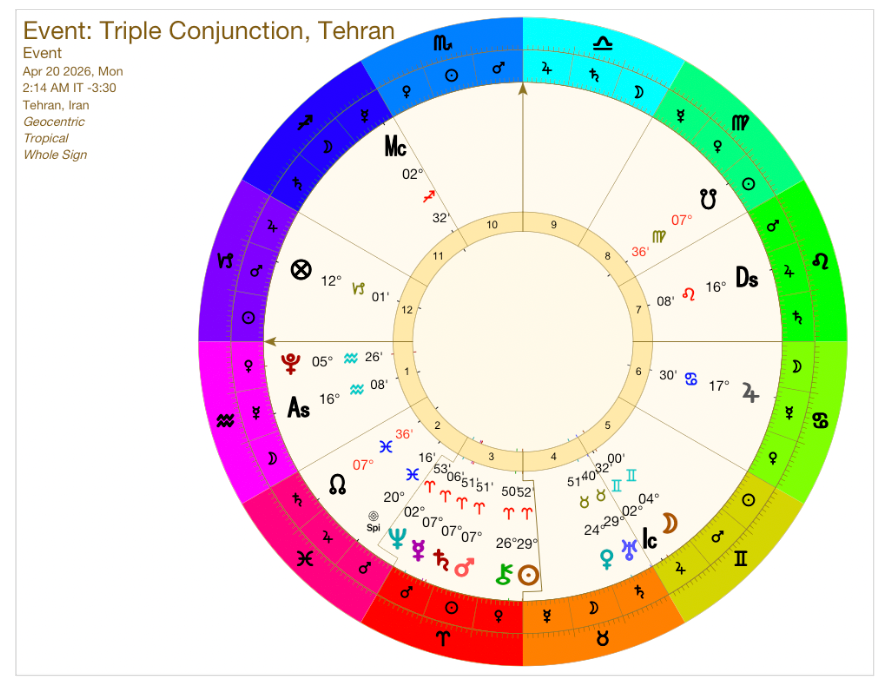
April 19 — Mercury-Mars-Saturn triple conjunction — Aries 07°
Mercury, Mars, and Saturn reach simultaneous conjunction in Aries on April 19, 2026. The exact Mars-Saturn conjunction fires at 22:44 UTC; at that moment Mercury stands 0°46' from exact. The total arc span of all three planets: 0°46'. This is the tightest Mercury-Mars-Saturn configuration in the ninety-six-year record the author has surveyed.
Additional simultaneous activations on April 19: the NYMEX WTI secondary progressed Moon reaches conjunction with the IRGC founding Sun at Taurus 19°14' within 0°06'; the Tehran chart places all three planets in the second house of national resources and treasury; Uranus stands at Taurus 29°39', seven days from its Gemini ingress; and transit Saturn on the triple-conjunction day stands 0°36' from OAPEC natal Saturn.
April 23 — Venus conjunct Uranus — Taurus 29°
Venus reaches exact conjunction with Uranus at Taurus 29°, the identified ceiling of the Venus-in-Taurus price-elevation phase.
April 26 — Uranus ingresses Gemini
Uranus enters Gemini on April 26, 2026, for the first time since 1949. The corpus's multi-chart activation register documents six petroleum-founding entity charts with natal positions acutely sensitized to this transit.
The most precise activation concerns the Gulf Cooperation Council. The GCC was founded on May 25, 1981, expressly as the collective security and political-economic framework of the six Gulf Arab states — its foundational rationale being the coordination of a unified Arab Gulf response to Iranian regional power. The GCC's natal Uranus stands at Scorpio 27°51'. At the outbreak of the war on February 28, 2026, transiting Uranus stood at Taurus 27°42' — within 0°09' of exact opposition to this natal position.
In any natal chart, the Uranus opposition — transit Uranus in exact opposition to natal Uranus — is the mid-life structural crisis: the moment at which the entity's foundational architecture faces maximum disruption from within and without. For the GCC, this opposition fires 0°09' from exact at the precise moment the institution faces the challenge its entire founding rationale was designed to meet. The actual consequence is visible: GCC member states have not responded as a coherent bloc, and GCC infrastructure has sustained direct kinetic strikes. The institution founded to contain Iranian regional power is being physically struck and politically fractured simultaneously.
June 20 — WTI NYMEX secondary progressed New Moon — Taurus 21°28'
The NYMEX WTI crude oil contract's secondary progressed Moon reaches exact conjunction with the progressed Sun at Taurus 21°28' on June 20, 2026, coinciding with the summer solstice. This is the SP New Moon of the primary global crude oil pricing instrument — the inception of a new thirty-year cycle in the life of the WTI chart. The conjunction is simultaneous with the SP Mercury to the same degree, and with transit Saturn's conjunction to WTI natal Mercury. A progressed New Moon does not produce a discrete price event on a single day; it marks the structural seeding of a new cycle.
July 26 — Saturn retrograde station — Aries 14°45'
Saturn stations retrograde at Aries 14°45' on July 26, 2026. A stationing planet moves to apparent stillness and then reverses direction; in mundane work it is understood to dwell at its station degree with maximum intensity — not transiting through but pressing, for weeks, on the same structural point. The station degree is the precise center of the six-entity petroleum cluster described in Section 4.
Every one of those six founding entities is brought under simultaneous maximum Saturn pressure on July 26. Saturn's signification is systemic reckoning, structural consolidation through constraint, and the crystallization of consequences already set in motion.
Saturn's Transit Through the 14° Aries Cluster: June–August 2026
| Date | Saturn Position | Direction | Contact | Significance |
|---|---|---|---|---|
| ~June 28 | Aries 14°08' | Direct | Conjunct NIOC Mars | Iran's national oil operational force |
| ~June 29 | Aries 14°12'–14°13' | Direct | Conjunct Chevron Saturn; Baku Uranus | Western corporate structure; origin shock of oil |
| July 2 | Aries 14°26' | Direct | Conjunct BP Saturn; opposes USA Sibly Saturn (0°22') | Colonial Persian franchise; US petrodollar apparatus directly opposed |
| ~July 4 | Aries 14°41' | Direct | Conjunct IRGC Venus | Iran's revolutionary military |
| July 26 | Aries 14°45' | ℞ Station | All six core charts simultaneously | Structural climax — maximum compression |
| August 12 | Aries 14°31' | Retrograde | Eclipse III fires (Leo 20°02' on NYMEX IC) | Eclipse seals structural conditions into WTI foundation |
| August 24–25 | Aries 14°26'–14°08' | Retrograde | BP Saturn; NIOC Mars (second pass) | Second structural compression wave |
Saturn does not race through this cluster. It enters in late June, stations over it on July 26, and sweeps through again on the retrograde in August. The entire cluster is under sustained Saturn pressure for approximately eight weeks.
The USA Sibly natal Saturn at Libra 14°48' stands in direct opposition to this station point by 0°03'. Transit Saturn on the cluster, transit Saturn opposing USA Sibly Saturn, and USA Sibly progressed Mars simultaneously applying to natal Saturn — these are three concurrent Saturn contacts on the same axis. The petrodollar treaty apparatus — the foundational American stake in the petroleum order — is under maximum structural compression in this window.
Seventeen days after the Saturn station, Eclipse III fires at Leo 20°02', directly on the NYMEX WTI IC. The July 26–August 12 window is the primary structural inflection zone of 2026: Saturn freezes conditions at the cluster; eclipse seals them into the WTI chart's foundation. This is not two separate events. It is one sustained structural act in two movements.
6. Eclipse Analysis
Four eclipses fall in 2026. The author evaluates each against the corpus of petroleum natal charts and national charts relevant to the conflict.
| Eclipse | Date | Degree | Primary Corpus Contact |
|---|---|---|---|
| Solar Annular | February 17, 2026 | Aquarius 28°50' | Israel natal Mars (Leo 28°18') opposed, 0°32'; USA Sibly Moon conjunct, 1°40' |
| Lunar Total | March 3, 2026 | Virgo 12°53' | USA Sibly natal ASC partile square; USA Sibly SP ASC conjunct to exact arc-minute; DC Descendant occupied |
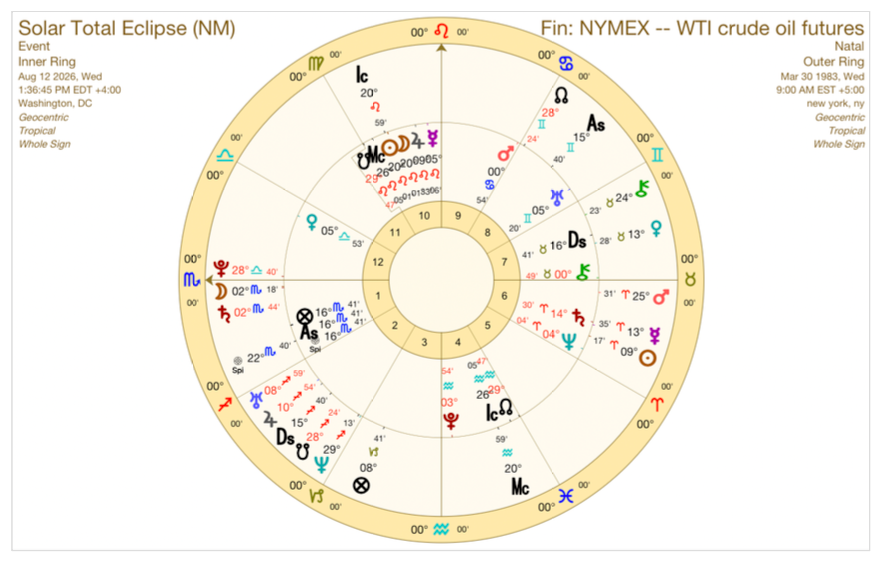
| Solar Total | August 12, 2026 | Leo 20°02' | NYMEX WTI IC (Leo 20°46'), 0°57'; 2006–07 Saturn-Neptune opposition degree, 0°12' |
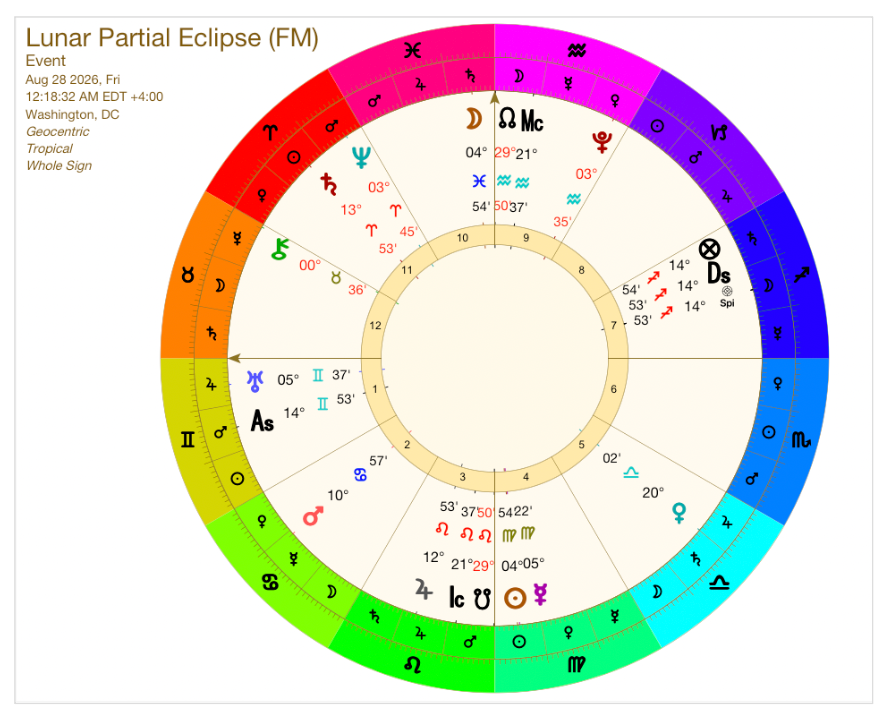
| Lunar Partial | August 28, 2026 | Pisces 04°51' | BRICS natal Saturn conjunct, 0°55'; 1973 Arab Embargo Neptune squared, ~1°; Israel natal Moon squared, 0°33' |
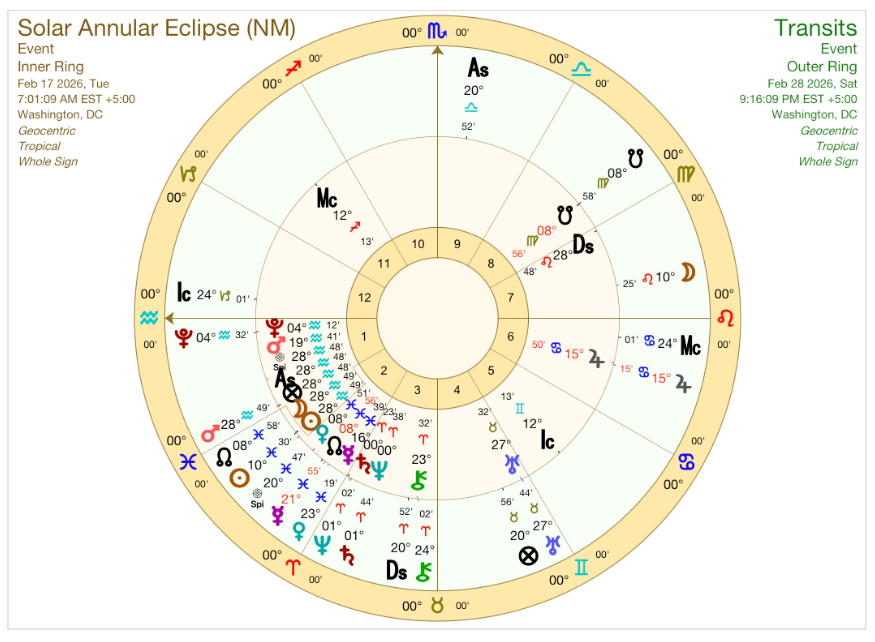
Eclipse I: Solar Annular Eclipse — February 17, 2026 — Aquarius 28°50'
The war's first eclipse preceded the outbreak of hostilities by eleven days. Every significant contact in this eclipse is Mars. The eclipse fell at Aquarius 28°50', in direct opposition to Israel's natal Mars at Leo 28°18'. Mars is the planet of military force, kinetic action, and war. An eclipse opposing a nation's natal Mars, from the most public degree of a Fixed sign, announces the coming period in unmistakable terms: this nation's martial principle is the subject of what follows.
Simultaneously, the eclipse conjuncted the USA Sibly natal Moon at Aquarius 27°10'. The Moon represents the American public — its collective emotional body, its mass relationship to events. The eclipse landed on both the Israeli Mars and the American Moon simultaneously: the same degree announced Israel's military operation and pulled the United States into it through its public body.
The mechanism of delivery was the eclipse-trigger. In classical mundane practice, an eclipse plants a structural charge at its degree; that charge fires when a fast-moving planet reaches the same point. On February 28, 2026 — eleven days after the eclipse — transit Mars arrived at Aquarius 28°21', within half a degree of the eclipse point. The war began that day. The chain is precise: eclipse at the degree of Israel's natal Mars on February 17; Mars transits the eclipse degree on February 28; war ignites. This is the eclipse-trigger mechanism in its cleanest form.
Eclipse II: Lunar Total Eclipse — March 3, 2026 — Virgo 12°53'
The second eclipse is the author's most consequential for understanding American involvement.
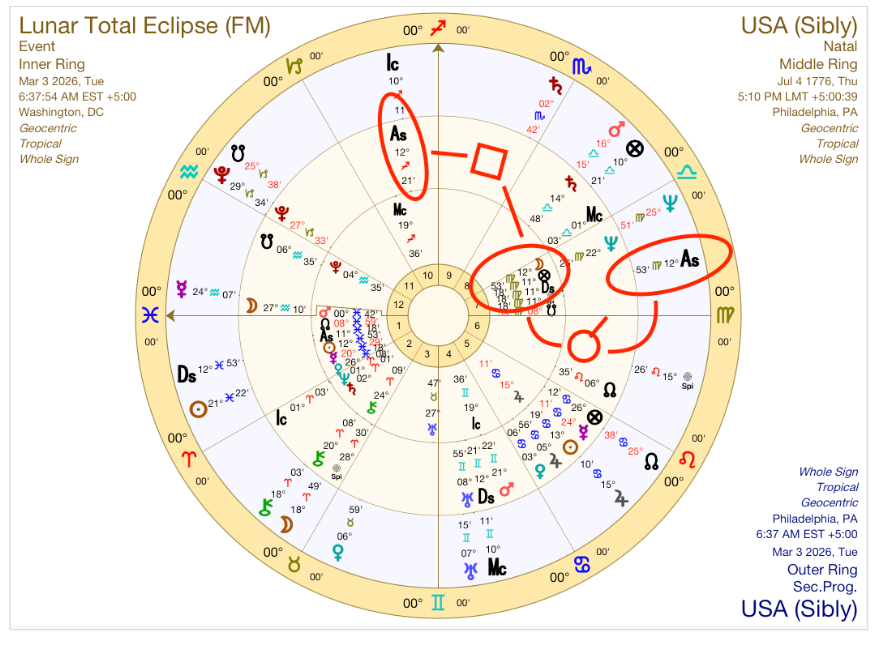
The Full Moon eclipse of March 3 fell at Virgo 12°53'. In the USA Sibly natal chart — July 4, 1776, 5:10 PM LMT, Philadelphia — the Ascendant stands at Sagittarius 12°21'. The eclipse forms a square aspect across the same degree: Virgo 12° squaring Sagittarius 12°. In classical practice this is a partile square — the two bodies occupying the same degree number across a ninety-degree angle, the most direct expression of the square aspect's confrontational force.
The secondary progressions of the USA Sibly chart to March 3, 2026 provide a finding more precise still. The secondary progressed Ascendant for that date stands at Virgo 12°53' — to the exact degree and arc-minute. The eclipse did not merely square the natal Ascendant to the same degree; it fell on the precise arc-minute of the progressed Ascendant simultaneously. This contact has been confirmed by direct computation in AstroGold.
There is a third dimension. Cast for Washington DC, the March 3 eclipse placed the eclipsed Full Moon precisely on the Descendant — the seventh-house cusp, the horizon angle that governs open enemies, declared adversaries, and the nation's relationship to war it enters through the agency of others. Natal Ascendant squared to the same degree, progressed Ascendant conjunct to the exact arc-minute, and the eclipse Moon on the Washington DC Descendant simultaneously: three distinct angular statements, three distinct layers of the same verdict.
The United States is structurally consigned to this conflict. A nation whose progressed Ascendant is the eclipse itself — not aspected by it, but coincident with it to the arc-minute — is not in a peripheral relationship to the eclipse's structural implications. Its progressed horizon is already the eclipse.
The USA Sibly progressed Mars stands at Libra 16°15', retrograde, applying toward the natal Saturn at Libra 14°48'. Progressed Mars closing on natal Saturn — itself in direct opposition to the 14-degree Aries petroleum cluster and to the July 26 Saturn station — places the nation's progressed military force in structural confrontation with the petroleum order's foundational axis.
Eclipse III: Solar Eclipse — August 12, 2026 — Leo 20°02'
The third eclipse falls at Leo 20°02'. The NYMEX WTI crude oil contract has its Imum Coeli — the chart's foundation angle — at Leo 20°46'. The eclipse falls within 1° of the IC of the primary global crude oil pricing instrument, constituting a direct activation of the chart's foundational conditions. In mundane analysis, an eclipse on the IC of a market chart indicates disruption to the instrument's foundational operating conditions: not necessarily a price spike but a structural change to the mechanics of pricing itself.
The author reads Eclipse III as the structural embedding of the new pricing regime: whatever conditions have been established by the June 20 progressed New Moon and the July 26 Saturn station are crystallized by this eclipse contact into the WTI chart's foundation. Eclipse III falls seventeen days after Saturn's retrograde station at the 14-degree Aries cluster.
Eclipse IV: Lunar Partial Eclipse — August 28, 2026 — Pisces 04°51'
The fourth eclipse of 2026 falls at Pisces 04°51', sixteen days after Eclipse III. Where Eclipse III activates the WTI pricing mechanism, Eclipse IV reaches into the monetary and geopolitical architecture surrounding oil.
The BRICS founding chart carries natal Saturn at Pisces 03°56' retrograde — within 0°55' of the eclipse degree. BRICS natal Saturn eclipsed is the dollar-alternative monetary bloc placed under maximum structural pressure at its own foundational constraint: the precise degree of the institutional caution and systemic resistance that has slowed BRICS financial integration since its founding.
Further: the Yom Kippur War Neptune and the Arab Oil Embargo Neptune are both within 1° of exact square to this eclipse point. The 1973 oil weapon — the foundational moment at which Arab petroleum producers used supply denial as a geopolitical instrument for the first time — is invoked in its Neptune dimension by the August 28 eclipse. Israel's natal Moon is in exact square within 0°33'.
Eclipse IV is the monetary and geopolitical layer of the summer 2026 structural sequence: Eclipse III seals the pricing mechanism; Eclipse IV seals the monetary architecture around it.
7. The War Arc: Five Structural Phases
The following synthesis maps the astrological calendar of the conflict from its opening kinetic phase through its structural resolution horizon in April 2028. Each phase is defined by the dominant planetary mechanism operating in that period.
Phase 1 — Kinetic Ignition (February 28 – May 1, 2026)
The opening phase is defined by Mars transiting through early Aries, activating in sequence every foundational planet in the petroleum corpus cluster. The April 10 Mars ingress into Aries marks the war's transition from aerial and technological operations toward direct kinetic engagement. The April 11 window, when Mars reaches Aries 01°01', is the analytically most specific strike prediction in the corpus for this phase — the precise degree of the Fordow nuclear facility's natal Uranus, embedded in H12 of the war nativity alongside the Saturn-Neptune conjunction.
The April 19 triple conjunction of Mercury, Mars, and Saturn at Aries 07° is the formal articulation of war terms: a public declaration of conditions, demands, or framework, most likely concerning Hormuz access or oil supply arrangements — the moment at which what has been operating in the twelfth house begins to surface as declared reality.
By April 27–28, Mars sweeps the full fourteen-degree cluster in approximately twenty-four hours, activating every foundational entity — NIOC, BP, Chevron, Baku, Masjed Soleyman, and the IRGC — in sequence within a single day. This is the war's period of maximum kinetic concentration.
Phase 2 — Structural Compression Peak (May 19 – July 26, 2026)
On May 19, Saturn makes its first of three conjunctions with the Iran Islamic Republic natal Sun. The three-pass structure — May 2026, October 2026, February 2027 — means the Iranian governmental apparatus is under maximum institutional pressure across nine months.
By late June, Saturn enters the fourteen-degree cluster and the secondary progressed New Moon in the WTI NYMEX chart occurs on June 20 — the structural hinge of the war's first phase, seeding the new thirty-year pricing cycle on the summer solstice. Saturn stations retrograde on July 26 at Aries 14°45', pausing directly over the entire foundational cluster while in exact opposition to the United States natal Saturn in Libra.
This is the structural climax: the maximum simultaneous compression of Iranian oil sovereignty (NIOC Mars), Western corporate oil framework (Chevron and BP Saturn), and the diplomatic architecture of the petrodollar system (USA Saturn opposing from Libra). July 26 is the predicted ceiling window for both oil price and conflict structural pressure.
Phase 3 — Eclipse Sealing and Strategic Fog (August 12 – December 10, 2026)
The August 12 solar eclipse at Leo 20°02' strikes the NYMEX WTI Imum Coeli at 0°57' orb — the foundation angle of the oil pricing instrument. August 28 brings a lunar eclipse activating the 1973 Arab Oil Embargo chart and the BRICS founding chart simultaneously, bringing the de-dollarization question from background to foreground.
Through autumn 2026, Saturn's retrograde carries it back through the fourteen-degree cluster for its second pass, deepening the structural compression. Neptune's retrograde station in July cloaks the nuclear and covert dimensions in strategic fog. Saturn stations direct on December 10 — the end of the first structural war phase. What began in February is institutionally settled by December, though not necessarily militarily resolved.
Phase 4 — Second Campaign and Order Restructuring (January – August 2027)
Saturn's third and final pass through the fourteen-degree cluster occurs in March 2027, completing the triple transit of the oil system's foundational structure. On May 11, 2027, Saturn conjuncts IRGC natal Mars — the specific astrological signature of the force that has controlled Hormuz since the war began. This is the predicted date on which the Hormuz closure mechanism is either formally resolved or structurally broken.
On August 9, 2027, Saturn stations retrograde at Aries 27°53', conjunct Saudi Aramco's progressed Uranus — indicating a structural disruption to Saudi oil operations that is the second major infrastructure event of the war's arc. The post-war energy geography begins to take institutional form during this phase.
Phase 5 — Settlement Horizon (December 2027 – April 2028)
On March 30, 2028, Saturn activates the 1987 Operation Earnest Will chart — the US naval escort operation that established the precedent of direct American military protection of Gulf oil shipments. A Saturn transit to that precedent-setting chart does not restore the original arrangement; it restructures it.
The predicted outcome is a new Gulf maritime security framework, multilateral in character, no longer exclusively US-guaranteed. On April 13, 2028, Saturn exits Aries. The structural war phase is complete.
8. The April 19–20 Declaration Window
Mercury governs formal declaration and the articulation of terms. Mars governs kinetic force and military pressure. Saturn governs institutional constraint and the crystallization of structural law. In classical mundane practice, their tight conjunction marks the moment at which conditions established by force are formally stated — terms declared, structures consolidated, the war's operative reality given institutional form.
The author has surveyed tight Mercury-Mars-Saturn configurations across oil-system transitions over ninety-six years. Three prior cases are directly relevant:
- March 1998: Mercury stationary at Aries 09°24' conjunct Saturn at Aries 09°10' (0°14' orb) produced a formal supply declaration that ended a catastrophic price collapse — same sign, same structural type
- December 1986: Mercury-Saturn conjunct in Sagittarius (0°24') with Mars in Pisces forming a T-square produced the Vienna accord re-establishing OPEC quotas, ending a two-year internal price war
- April 19, 2011: Mercury conjunct Mars in Aries (0°12') in opposition to Saturn in Libra (0°57') marked the moment of maximum structural tension in the Libyan supply disruption
The 2026 configuration — Mercury at Aries 07°06', Mars and Saturn at Aries 07°52', total arc of 0°46' — is tighter than any of them.
The exact Mars-Saturn conjunction fires at 22:44 UTC on April 19 (02:14 IRST April 20). Mercury stands 0°46' from exact — all three planets within a single degree simultaneously. In Tehran's chart the conjunction falls in the second house of national resources and treasury. Transit Saturn on the same day stands within 0°36' of OAPEC's natal Saturn at Aries 06°30', the Arab oil-weapon archetype under structural reckoning since April 9.
With Hormuz functionally closed and physical crude at war-high prices, the configuration identifies this window as the moment at which the war's structural terms are formally declared: not necessarily a ceasefire, not necessarily a military escalation, but the formal articulation of on what terms the new petroleum order begins — what currency, what routing arrangement, what institutional form the reorganization takes.
— The Markets —
9. The Price Picture
Physical vs. Forward: A Structural Spread
Two distinct price signals currently require separate interpretation. The dated Brent price — physical crude for immediate delivery through non-Hormuz supply routes (West African, North Sea, US Gulf) — reached $141 per barrel in early April 2026: what refiners pay for oil that can be moved today, reflecting acute scarcity from a closed Strait. The Brent futures contract for June delivery trades near $108 — the market's discounted expectation of eventual Hormuz normalization. A $33 spread constitutes extreme backwardation: the market believes some reopening will occur, but cannot determine when. The structural astrological indicators do not support convergence on the forward price as the near-term floor.
The Venus-in-Taurus Price Phase
Venus entered Taurus on March 30, 2026 — her domicile, the sign of fixed earth and physical accumulation — and will exit approximately April 25. Venus in Taurus applies sympathetic pressure to the valuation of physical goods; oil, as the primary material resource underlying all industrial production, is directly within her domain. The same-day confirmation (Venus ingress = WTI new war high, March 30) is a within-war observation rather than a historical survey result; the author presents it as such. The ceiling of the Venus-Taurus price phase is April 23, when Venus reaches exact conjunction with Uranus at Taurus 29°.
The structural forward signal is the NYMEX WTI secondary progressed New Moon on June 20 — the inception of a new thirty-year pricing cycle, seeded under Saturn's approach to the petroleum cluster and the first eclipse directly on the WTI foundation angle in August. The pricing regime that emerges from this summer will be structurally distinct from the one that preceded the war.
10. Scenario Analysis
The author maps three structural outcomes for the petroleum order through 2026 and beyond. These are not probability brackets — the astrological method is not a polling instrument — but descriptions of the structural character each outcome would take, and of the indicators that point toward each.
Scenario I: Containment and Return
The conflict ends on terms that restore dollar-denominated Hormuz transit within 2026. Iranian operational capacity is substantially degraded; a successor authority accepts the terms of the engagement; the stated US-Israeli objective of nuclear-program dismantlement is achieved or credibly claimed. Physical crude prices converge back toward forward expectations.
The astrological objection is fundamental. The March 3 eclipse's triple angular activation of the USA Sibly chart — partile square to the natal Ascendant, exact arc-minute conjunction to the progressed Ascendant, and the eclipse Moon on the Washington DC Descendant simultaneously — is not the structural signature of a contained engagement. An eclipse occupying the exact arc-minute of the USA's progressed horizon does not resolve before those progressed conditions have run their course. The indicators say the USA cannot back out. They do not say it is winning.
Scenario II: The Currency Architecture War
The more structurally coherent reading of present conditions: Hormuz is not simply closed — it is operating as a political instrument of currency selection. Iranian forces have demonstrated the capacity to discriminate between dollar-denominated and yuan-denominated maritime traffic. The conflict has become a structural contest over which monetary system governs energy commerce, conducted simultaneously through kinetic and financial means.
Iran's military posture at the time of writing is operationally ascendant, not fractured. Gulf-state infrastructure across the Arabian Peninsula has sustained severe and sustained strikes. Dubai's commercial life has been effectively suspended. Saudi oil fields, desalination plants, and data infrastructure have been struck. Kuwait, Bahrain, and UAE-adjacent positions have received direct blows to critical systems. Iranian forces are conducting offensive operations, not absorbing defeat.
The structural consequence of this posture is already visible: the yuan-Hormuz architecture — the arrangement by which Chinese-aligned energy commerce transits while dollar-aligned commerce is blocked — has been physically instantiated for the first time in the history of the Strait. The petrodollar system was built on the premise of universal Hormuz access under American military guarantee. That premise no longer holds uncontested.
The June 20 SP New Moon seeds the new pricing cycle in this environment; the July 26 Saturn station crystallizes the structural conditions under which it begins. The cycle seeded on June 20 is, on this reading, the opening of a post-petrodollar energy pricing era.
The planetary background for this reading requires precision. The Saturn-Neptune cycle that is completing in 2026 was born in opposition across Gemini-Sagittarius in 1971–74 — the exact years when Nixon severed the dollar-gold link and the US-Saudi petrodollar arrangement was improvised in its place. The 2026 Saturn-Neptune conjunction is in Aries at the World Point: qualitatively different from prior aspect phases. The cycle that built the petrodollar under tension is completing in conjunction — unified ignition at the cardinal degree of initiatory force.
More specifically: transit Neptune in Aries stands in direct opposition to the natal Pluto of the US-Saudi Petrodollar Agreement chart at Libra 04°07', within less than half a degree. Neptune opposing the petrodollar's natal Pluto dissolves the coercive power at the foundation of the system. This is the specific planetary contact that identifies 2026 as the dissolution phase — not a disruption within the petrodollar order, but a dissolution of its structural premise.
Scenario III: The Interregnum
The distinction between Scenario II and Scenario III is not one of violence — the conditions of Scenario III are already partially present. The distinction is whether what follows the war is a restructured petroleum order (new pricing conventions, new currency arrangements, new geopolitical guarantors replacing the old ones) or a genuine interregnum: a period in which no stable pricing architecture exists because the old one has been destroyed faster than any new one can be constituted.
The 2028 NYMEX Uranus opposition represents the outer temporal boundary of the author's structural claim. If no new order has begun crystallizing before that opposition fires at the same degree as the USA Sibly Uranus return, the interregnum continues into the decade's second half.
On Prediction and Falsifiability
The scenarios above are structural descriptions, not forecasts with attached confidence levels. The method is tested through its specific dated predictions. P-07 through P-22 are on record with named contact dates, specific planets, and described structural character. If the April 9–26 window — the OAPEC Saturn return, Mars at Fordow's natal Uranus, and the tightest Mercury-Mars-Saturn conjunction in ninety-six years — passes without identifiable structural declaration or kinetic escalation in the identified windows, that is a meaningful failure of the document's most specific predictive claim. The predictions are falsifiable through their specificity; their falsification would require revision of the method, not merely the conclusions.
11. The Long Arc: 2026–2039
The corpus's central structural argument extends well beyond the current conflict.
The Saturn-Neptune cycle identifies 2026 as a conjunction point — a structural resetting of the petroleum order, not merely a supply disruption within it. Each prior conjunction of this cycle has coincided with a transformation in the petroleum order that outlasted the immediate crisis by years or decades: the formation of the Standard Oil trust era at the 1882–83 conjunction; the nationalization wave and pricing revolution of the mid-century at the 1952–53 conjunction; the Gulf War I and post-Cold War restructuring of supply relationships at the 1989 conjunction. The 2026 conjunction — at the World Point — carries the structural signature of a transformation in the order itself.
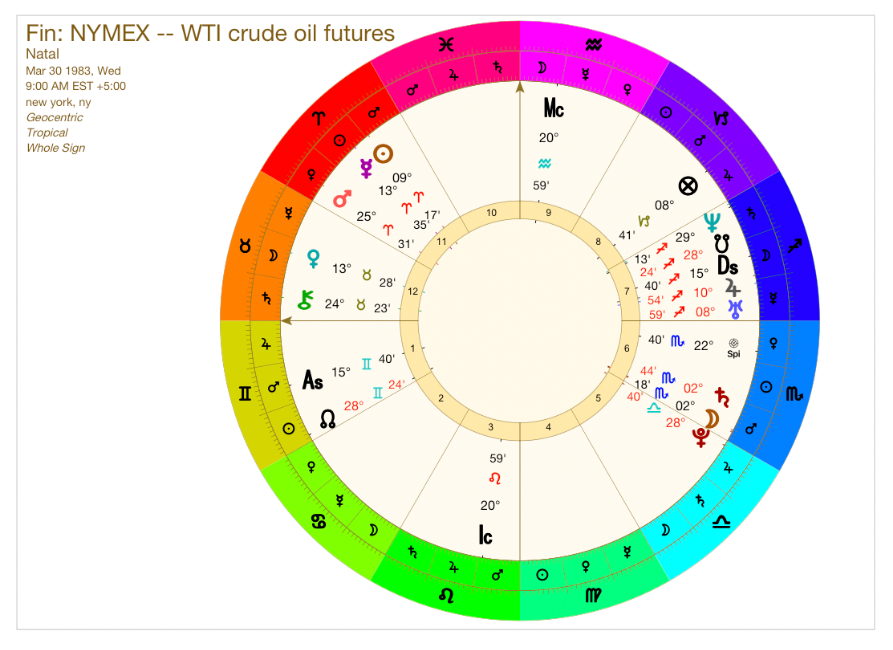
The NYMEX WTI chart's Uranus opposition fires around 2028: transiting Uranus at Gemini 09°00' opposing natal Uranus at Sagittarius 09°00'. The USA Sibly natal Uranus stands at Gemini 08°55'. The separation between the WTI Uranus opposition point and the USA Sibly natal Uranus is 0°05' — essentially the same degree. The WTI Uranus opposition and the USA Sibly Uranus return fire at the same zodiacal degree in the same year.
The base case for the decade arc projects a 55–70% departure from the pre-war petroleum status quo by 2028–2030. This is a prediction of transformation, not of any particular form of collapse. The petrodollar system, the Brent benchmark's pricing architecture, and the post-1973 consensus on which nations control the oil trade's financial infrastructure are all within the transformation window.
The entity charts most positioned to inherit the structural function currently held by the petrodollar apparatus — the BRICS founding chart, the Shanghai INE yuan crude futures chart, and the GCC diversification frameworks — show activations that run concurrent with and subsequent to the petrodollar dissolution contacts. The political form that transformation takes cannot be predetermined by astrological analysis; the timing of maximum structural instability can.
The Earnest Will Activation: April 2028
Operation Earnest Will (1987–88) was the US military escort operation that defended Kuwaiti tankers during the Iran-Iraq war — the most direct American precedent for Gulf protection operations, and the foundational act of US military commitment to free passage through the Persian Gulf. The Earnest Will natal chart carries Jupiter at Aries 28°25'. Saturn will reach exact conjunction with this position in April 2028, concurrent with the NYMEX Uranus opposition.
The Earnest Will activation marks the formal closing of the previous Gulf protection cycle at the precise moment the next structural rupture fires. The predicted outcome is a new Gulf maritime security framework, multilateral in character, no longer exclusively US-guaranteed. On April 13, 2028, Saturn exits Aries. The structural war phase, as defined by this document's astrological calendar, is complete.
12. Methodology
This document applies classical mundane astrology to the petroleum system as a structured set of institutional natal charts. It does not assert causal mechanism between celestial positions and earthly events. It asserts timing correlation, documented through prediction formulation before events and compared systematically against confirmed outcomes.
On natal chart selection: The corpus uses publicly documented founding dates for petroleum entities where available. Where exact times are uncertain, interpretive weight is calibrated accordingly and noted in the main corpus index. The WTI NYMEX chart (March 30, 1983, 09:00 EST, New York) and Brent IPE chart (June 23, 1988, 08:30 UTC, London) are based on market opening records.
On the cluster finding: Fifty-five charts containing ten primary planets each produce 550 planetary positions distributed across the zodiac. Finding six positions from independent founding charts within a 1°03' arc at a single zodiacal point is statistically unusual. The author draws predictive weight from this clustering in combination with the precision of the Saturn station point alignment — not from the clustering alone.
On secondary progressions: The USA Sibly progressed Ascendant finding (Virgo 12°53', confirmed at the exact arc-minute of the March 3 eclipse) depends on the natal birth time of 5:10 PM LMT, July 4, 1776, Philadelphia. This is the standard working reference for the Sibly chart and is used consistently throughout the corpus. The finding has been confirmed by direct computation in AstroGold.
On prediction and falsifiability: The predictions in this document are falsifiable through their specificity — named dates, named planets, named structural contacts — not through price thresholds that depend on many factors beyond the astrological indicators. The April 9–26 window, the July 26 Saturn station, and the August 12 eclipse contact each carry identifiable structural signatures. Failure to produce events commensurate with those signatures constitutes genuine failure of the method. The author invites that standard.
13. Postscript
The thesis of this document is that the configurations of 2026 constitute the celestial conditions under which a transformation of the petroleum order becomes structurally inevitable — not a disruption within the existing order, but a transformation of it. That thesis stands or falls on specific events in a specific window.
The next three months — April 9 through August 12, 2026 — contain every major structural prediction on record in this document: the OAPEC Saturn return, the Mars-Fordow Uranus contact, the tightest Mercury-Mars-Saturn conjunction in ninety-six years, the Saturn station at the heart of the six-entity petroleum cluster, and the first solar eclipse directly on the NYMEX WTI foundation angle.
What happens in that window, measured against the predictions on record and the falsification criteria stated in the methodology, will determine whether the argument in these pages is substantiated or requires revision. The author has committed to the standard. The clock is running.
Appendix: Key Dates at a Glance
| Date | Event |
|---|---|
| Feb 17, 2026 | Eclipse I (Aquarius 28°50') — Israel natal Mars opposed; USA Sibly Moon conjunct; Mars war announced |
| Feb 28, 2026 | War outbreak — Mars triggers Eclipse I degree; Saturn-Neptune conjunction in H12 of war nativity |
| Mar 3, 2026 | Eclipse II (Virgo 12°53') — USA Sibly natal ASC partile square; SP ASC conjunct exact arc-minute; DC Descendant occupied |
| Apr 9, 2026 | Saturn conjunct OAPEC natal Saturn — Arab oil-weapon archetype at structural reckoning |
| Apr 10, 2026 | Mars ingresses Aries — kinetic phase transition |
| Apr 11, 2026 | Mars conjunct Fordow natal Uranus (Aries 01°01') — nuclear facility strike window |
| Apr 19, 2026 | Mercury-Mars-Saturn triple conjunction (Aries 07°) — tightest in 96 years; formal declaration window |
| Apr 23, 2026 | Venus conjunct Uranus (Taurus 29°) — ceiling of Venus-in-Taurus price phase |
| Apr 26, 2026 | Uranus ingresses Gemini — first time since 1949; GCC Uranus opposition exact |
| Jun 20, 2026 | WTI NYMEX SP New Moon (Taurus 21°28') — summer solstice; new 30-year pricing cycle seeded |
| Jun 28 – Jul 26 | Saturn transits 14° Aries cluster — six foundational entity charts under simultaneous compression |
| Jul 26, 2026 | Saturn retrograde station (Aries 14°45') — structural climax; predicted price ceiling |
| Aug 12, 2026 | Eclipse III (Leo 20°02') — NYMEX WTI IC at 0°57'; structural sealing of new pricing regime |
| Aug 28, 2026 | Eclipse IV (Pisces 04°51') — BRICS Saturn conjunct; 1973 Arab Embargo Neptune squared; de-dollarization arc |
| May 11, 2027 | Saturn conjunct IRGC natal Mars — Hormuz closure mechanism formally tested |
| Apr 2028 | Saturn activates Earnest Will chart (Jupiter Aries 28°25'); Saturn exits Aries — structural war phase complete |
This document supersedes Oil Corpus — Reader Summary v2. Jon Kraft, April 3, 2026. The main corpus (Oil Corpus — Iran War 2026, Parts I–X) contains the full technical apparatus from which this summary is derived. Chart Entry Sheet: approximately fifty-five entities indexed, LIB-1900 through LIB-2568. Real Event Log: confirmed events E-01 through E-29.
Finalized: 10:30 PM PDT, April 3, 2026 · Portland, Oregon